Polycarbonate fails in service for one reason more than any other: the wrong coating, or no coating at all. The base material is strong, lightweight, and optically clear. Without a hard coat matched to the application, it hazes, scratches, and degrades until it needs replacement. With the right coating, it outlasts the equipment it is installed in.
The problem is that "hard coat" covers a wide range of performance levels, and the specification numbers that distinguish them are not self-explanatory to engineers who do not work with them daily. Taber haze, ASTM D1044, Taber cycles, haze percentage — these terms appear on coating data sheets without much context for what they mean in practice.
This guide explains what the numbers mean, how the five Fusionite coating grades differ from each other, and how to match coating grade to the environment your window will actually operate in.
What Taber Abrasion Testing Measures
The Taber abrasion test, standardized under ASTM D1044[1], is the primary method for quantifying the scratch resistance of transparent plastic surfaces. The test works by pressing a pair of abrasive wheels against a rotating plastic sample under a controlled load for a specified number of revolutions. After the test, optical haze is measured on the abraded area and compared to the pre-test baseline.
The result is expressed as a haze percentage change after a set number of cycles. A coating that shows 2% haze increase after 500 cycles performs meaningfully better than one showing 8% increase after the same number of cycles. The lower the haze increases, the more abrasion-resistant the coating.
Two variables matter when reading Taber data: the haze percentage and the number of cycles at which it was measured. A coating rated at 3% haze after 500 cycles is not equivalent to one rated at 3% haze after 1,000 cycles. The second coating has been through twice the abrasion and still meets the threshold, which means it will last longer in service before reaching the same haze level.
Most applications specify a maximum acceptable haze level. Once a window exceeds that threshold, optical quality is noticeably affected and replacement is required. The Taber data tells you how quickly a given coating approaches that threshold under controlled abrasion conditions.
What Haze Percentage Means in Real Terms
Haze is measured per ASTM D1003[2] as the percentage of transmitted light that deviates more than 2.5 degrees from the incident beam. It is the metric for how much a surface scatters light rather than transmitting it cleanly.
A new, clean polycarbonate surface typically measures below 1% haze. At that level, optical clarity is essentially indistinguishable from glass. As haze increases, the visible effect depends on the application.
At 3 to 5% haze, a slight cloudiness or milkiness becomes apparent in direct transmitted light. For most industrial windows, this level is still functional. Operators can see through the window and safety is not compromised.
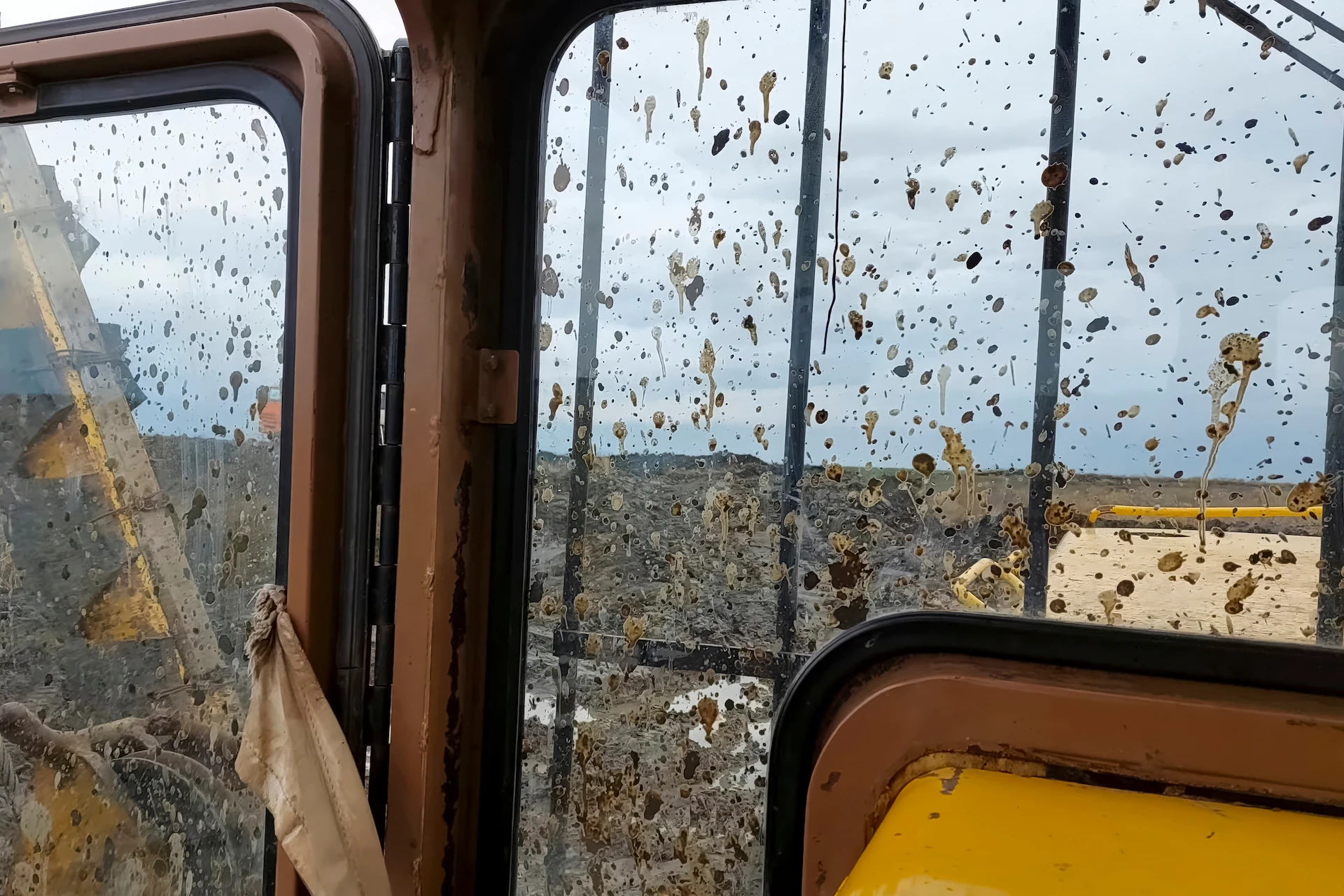
At 10% haze and above, the effect is clearly visible and affects operator visibility in demanding conditions, particularly in low-light environments or when looking into a bright light source. For cab windows on heavy equipment, forestry machines, or transit vehicles, this level of haze creates a safety concern.
For optical applications like LiDAR sensor windows, machine vision, or camera systems, even 3 to 5% haze can measurably affect performance. The scatter introduced by a moderately hazy window adds noise to sensor data and reduces effective detection range. Sensor window specifications typically require haze levels below 2% throughout the service life of the component.
The Five Fusionite Coating Grades Explained
Five Star's Fusionite coating line covers the full range of polycarbonate coating requirements, from general industrial applications to rail safety glazing and specialized anti-fog work environments.
CGI: Weatherable Hard Coat
The baseline grade. Standard UV stabilization and abrasion resistance for general industrial applications not subject to extreme environmental conditions. Appropriate for interior applications or protected exterior windows where UV exposure and abrasion are moderate.
CGFII: Formable Weatherable Hard Coat
Designed specifically for applications that require forming after coating. Standard hard coats crack when bent. CGFII is engineered to remain intact through cold bending or thermal forming operations, which allows the coated sheet to be shaped into complex geometries without compromising the coating. The Polycool material option is available in this grade, providing natural light transmission with reduced heat transfer for applications where solar heat gain inside a cab or enclosure is a concern.
Primary applications: motorcycle windscreens, ATV and UTV windshields, race car windows, face shields, and any application requiring formed shapes from pre-coated sheet.
CGAF: Anti-Fog Coated
Validated at more than two minutes fog-free at 60°C, certified under EN-166:2001[4]. The EN-166 standard is primarily associated with personal protective equipment, and CGAF is used extensively in face shields, safety visors, and helmet eyeports. The same anti-fog performance applies in heavy equipment cab applications where operators transition between cold outdoor temperatures and a heated cab interior. CGAF eliminates the momentary vision loss that standard polycarbonate produces in these conditions.
Also carries the N-mark (anti-fog), K-mark (falling sand abrasion resistance), and UV mark from EN-166 testing.
CGII: Ultra-Weatherable Hard Coat
The workhorse grade for demanding outdoor industrial and automotive applications. Key specs:
- Taber haze below 3% at 500 abrasion cycles (ASTM D1044[1])
- Five-year Florida outdoor weathering data (ASTM D1435)
- Wiper abrasion resistance below 4% (ISO 5685 / FMVSS 108)
- FCA LP-463PB-31-01 compliance for automotive qualification
- Available with frit printing for direct glass replacement without threaded hardware
CGII is appropriate for heavy equipment cab windows, bus and transit side windows, automotive glazing, eVTOL and advanced air mobility applications, and any window that will see sustained UV exposure and regular cleaning over a multi-year service life.
CGIII: Ultra-Abrasion Resistant Hard Coat
The highest performance grade in the Fusionite line. Key specs:
- Taber haze below 2% at 1,000 abrasion cycles (ASTM D1044[1])
- FRA 49 CFR Part 223 (ballistic and impact) compliance
- FRA 49 CFR Part 238 (fire and smoke per ASTM E162 and E662) compliance
CGIII is the spec for rail car windows, mining and quarry equipment operating in fine particulate environments, any application where cleaning frequency is high or abrasive contact is sustained, and sensor windows requiring low haze throughout an extended service life.
The difference between CGII and CGIII matters most in environments where the window sees abrasion regularly. In a moderate environment, CGII delivers adequate service life. In a harsh environment, the extra abrasion cycle performance of CGIII translates directly into a longer replacement interval.
Other Coating Specifications That Affect Performance
Taber haze is the primary hard coat metric, but it is not the only specification that matters for real-world performance.
UV and weathering resistance. Polycarbonate yellows under UV exposure without UV stabilization in the coating. ASTM G155[3] xenon arc testing and ASTM D1435 outdoor Florida weathering data are the methods used to validate long-term UV performance. Five Star provides weathering data for CGII and CGIII grades. For windows installed on exterior faces of equipment operating in high-UV regions or at altitude, weathering data is worth requesting from any glazing supplier.
Wiper abrasion resistance. Any window that sees windshield wiper contact requires wiper-specific abrasion data. FMVSS 108 and ISO 5685 are the standards used. A coating that performs well in Taber testing but degrades under dry wiper contact fails in automotive and transit applications where wipers run in cold or dusty conditions. CGII and CGIII both carry wiper abrasion data.
Chemical resistance. Cleaning agents, hydraulic fluid, fuel, and common industrial solvents can attack polycarbonate coatings if the coating is not formulated to resist them. Chemical resistance testing is application-specific. Confirming the chemicals the window will encounter and validating the coating against those chemicals during the design process avoids warranty claims and field failures.
Anti-fog performance. For applications where condensation on the window interior is a safety concern, the EN-166:2001 anti-fog validation used for CGAF provides a standard basis for comparison. General claims of "anti-fog" without EN-166 test data are not equivalent.
How to Match Coating Grade to Your Application
The coating selection process starts with three questions about the operating environment.
What is the abrasion exposure? Industrial cleaning cycles, wiper contact, fine particulate environments, and regular human handling all drive Taber performance requirements upward. Low-abrasion applications can often be served by CGI or CGFII. High-abrasion environments require CGII or CGIII.
What is the UV and weathering exposure? Exterior windows on equipment operating in direct sun need five-year weathering data at minimum. Interior windows or protected exterior windows have more flexibility.
Are there special performance requirements? Fog resistance, forming requirements, rail certification, sensor optical performance, or ESD safety all point toward specific grades or formulations. These requirements narrow the field quickly.
A simple application-to-grade mapping:
- Formed windscreens and face shields: CGFII
- Anti-fog cab windows and visors: CGAF
- Construction, agricultural, and automotive exterior windows: CGII
- Rail car glazing, mining equipment, high-frequency cleaning environments, sensor windows requiring sustained low haze: CGIII
When an application falls between grades or involves multiple requirements, Five Star's engineering team can evaluate the specific environment and recommend the appropriate specification. Providing a description of the abrasion exposure, cleaning protocol, UV environment, and any special performance requirements gives enough information to make a confident recommendation.
Getting the coating grade right at the specification stage is significantly less expensive than discovering the wrong choice after the window is in service.
Five Star Fabricating manufactures all five Fusionite coating grades at its Twin Lakes, Wisconsin facilities, with large-format coating capability on sheets up to 8 feet by 11 feet. Test data is available for each grade against the ASTM standards listed above.
References
- ASTM D1044 — Standard Test Method for Resistance of Transparent Plastics to Surface Abrasion
- ASTM D1003 — Standard Test Method for Haze and Luminous Transmittance of Transparent Plastics
- ASTM G155 — Standard Practice for Operating Xenon Arc Light Apparatus for Exposure of Materials
- EN 166:2001 — Personal Eye Protection: Specifications