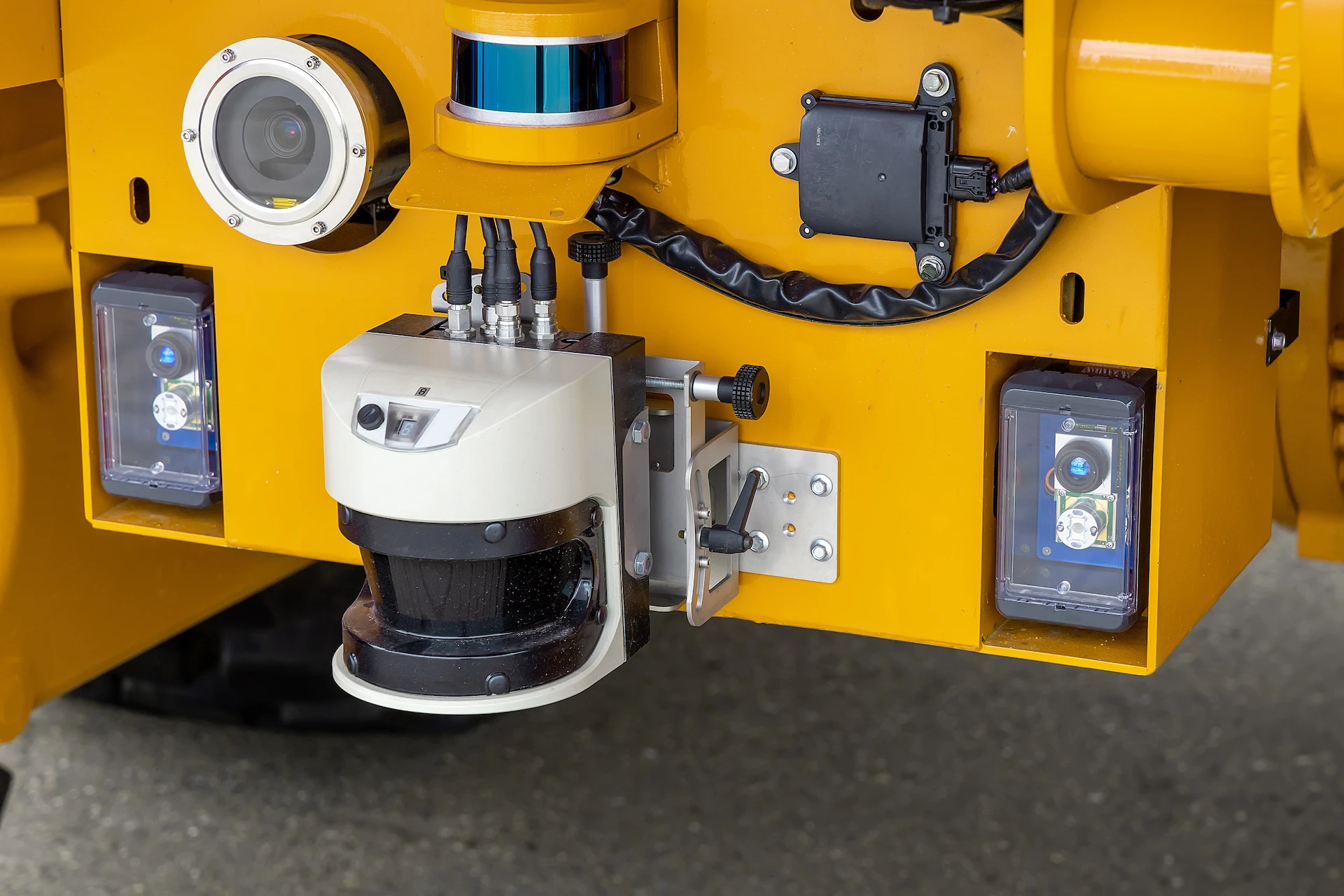
Robotics engineers spend significant time selecting the right LiDAR unit, optimizing sensor placement, and calibrating detection algorithms. The protective window between the sensor and the outside world often gets far less attention. That is a problem, because the window material and coating directly affect sensor performance, and the wrong specification degrades system reliability over time in ways that are difficult to diagnose.
Polycarbonate is widely used for sensor enclosures and protective windows in robotics. It handles impact, it is lightweight, and it machines cleanly. But not all polycarbonate performs the same in sensor applications, and the differences matter more as autonomous systems take on more demanding environments.
Here is what robotics engineers need to understand about polycarbonate window specification for LiDAR, camera, and machine vision systems.
What LiDAR Actually Needs from a Protective Window
LiDAR systems emit pulsed laser light and measure return times to build spatial maps. Any material placed in the optical path introduces variables: transmission loss, scatter, and reflections that add noise to the point cloud. The window material needs to minimize all three.
Optical transmission is the starting point. Clear-grade polycarbonate transmits approximately 92% of visible and near-infrared light, which covers the wavelength range most LiDAR systems operate in (typically 905 nm or 1550 nm). That transmission figure assumes a clean, low-haze surface. Haze is the critical variable.
Haze is measured per ASTM D1003[1] as the percentage of transmitted light that deviates more than 2.5 degrees from the incident beam. A new, uncoated polycarbonate sheet typically measures below 1% haze. That number rises as the surface accumulates scratches, and even modest haze increases scatter LiDAR returns in ways that affect point cloud quality. A window measuring 5% haze introduces enough diffuse scatter to create false returns and reduce effective range, particularly at longer detection distances.
This is why coating selection for LiDAR windows is not a secondary consideration. Five Star's Fusionite CGIII coating achieves Taber haze below 2% at 1,000 abrasion cycles per ASTM D1044. A window that holds low haze through years of environmental exposure and cleaning cycles maintains consistent sensor performance throughout the robot's service life. A window that hazes out after six months forces the engineering team to either replace the window on a maintenance schedule or accept degraded sensor data.
The geometry of the window also affects LiDAR. Flat windows introduce minimal optical distortion. Curved or domed windows, used in rotating LiDAR heads and 360-degree sensor arrays, must maintain consistent wall thickness across the curved surface to avoid variable refraction that shifts return point positions. Tight thickness tolerances during thermoforming are not optional in these applications. They are the difference between a calibrated system and one that drifts.
Camera and Machine Vision Windows Have Different Requirements
Camera-based systems, including stereo vision, RGB-D sensors, and machine vision inspection cameras, share some requirements with LiDAR but diverge in important ways.
Color accuracy matters for RGB and inspection systems in ways it does not for time-of-flight LiDAR. Polycarbonate is naturally slightly yellow-tinted in thick sections, though this effect is negligible at the window thicknesses used in most sensor enclosures (typically 3 mm to 6 mm). More relevant is any coating tint or absorption that shifts the spectral response of the sensor. Clear Fusionite coatings are spectrally neutral through the visible range, which preserves color fidelity for imaging systems that depend on accurate color differentiation.
Anti-reflective coatings reduce the ghost images and lens flare that internal reflections from window surfaces introduce into camera images. In machine vision applications where the system is looking for surface defects or dimensional deviations at tight tolerances, even subtle internal reflections add noise. An anti-reflective coating on the internal face of the sensor window reduces this effect without compromising the protective function of the outer coating.
Surface flatness and parallelism affect machine vision systems more than other sensor types. A window with measurable bow or thickness variation acts as a weak lens, shifting the apparent position of features in the image. For systems performing dimensional measurement or precision assembly guidance, that shift translates directly into measurement error. Five Star's CNC machining capability on 3, 5, and 6-axis equipment produces flat windows with consistent thickness and parallel faces to the tolerances these applications require.
ESD-Safe Materials for Electronics-Dense Environments
Standard polycarbonate is an insulator. In environments where static charge accumulates on robot housings and enclosure surfaces, a standard polycarbonate window can build and hold electrostatic charge that discharges into nearby electronics. For robots operating near sensitive circuit boards, servo drives, or sensor electronics, that is a real risk.
ESD-safe polycarbonate formulations dissipate static charge in a controlled way rather than holding it. The surface resistivity of ESD-safe polycarbonate typically falls in the range of 10^6 to 10^9 ohms per square, which is high enough to avoid current flow that damages electronics but low enough to prevent charge accumulation.
Five Star's robotics-specific polycarbonate solutions include ESD-safe material options for enclosures operating in electronics-sensitive environments. This is particularly relevant for collaborative robot (cobot) deployments where the robot housing is within reach of human operators, and for automated assembly lines where robots handle bare circuit boards or sensitive components.
The ESD specification needs to match the environment. Semiconductor manufacturing and PCB assembly environments often require tighter resistivity ranges than general industrial automation. Confirming the ESD classification required for the application before finalizing the window spec avoids a redesign after the robot is already in production.
Why Coating Grade Determines Long-Term Sensor Performance
The most common sensor window failure mode in industrial robotics is not impact damage. It is gradual optical degradation from surface abrasion in cleaning cycles, airborne particulate contact, and UV exposure in outdoor deployments.
Industrial robots get cleaned. Cleaning schedules in food processing, pharmaceutical, and electronics manufacturing environments involve solvents, high-pressure sprays, and abrasive wiping. Each cleaning cycle removes a small amount of coating. Over hundreds of cycles, an under-specified coating hazes to the point of requiring window replacement. In a production line where downtime is expensive, that replacement schedule is a cost the engineering team did not plan for.
Fusionite CGII handles this well for most indoor industrial environments: Taber haze below 3% at 500 cycles, wiper abrasion resistance below 4% per ISO 5685, and five-year Florida outdoor weathering data for outdoor-deployed robots. CGIII is the right choice for harsher conditions, delivering Taber haze below 2% at 1,000 cycles where cleaning frequency is high or the particulate environment is aggressive.
For outdoor autonomous systems, UV stability is an additional requirement. UV degradation yellows uncoated polycarbonate and reduces transmission over time, affecting both visible-wavelength cameras and near-infrared LiDAR. UV-stable Fusionite formulations maintain optical properties through extended outdoor exposure, which matters for agricultural robots, outdoor logistics automation, and construction site autonomous equipment.
Fabricating Complex Geometries for Sensor Integration
Many robotics applications require sensor windows with geometries that go beyond flat sheet. Rotating LiDAR heads use cylindrical or domed windows. Stereo camera rigs require precisely positioned dual windows in a single housing panel. Sensor arrays on autonomous mobile robots (AMRs) integrate multiple apertures into a single formed component.
Five Star's polycarbonate fabrication capabilities cover this range. Drape forming over precision tooling produces curved and domed geometries with the wall thickness consistency that sensor applications require. Thermoforming handles larger sensor housing panels and enclosure covers where a complex shape needs to be produced at volume. CNC machining on 3, 5, and 6-axis equipment machines mounting features, aperture cutouts, and edge profiles to tight tolerances that integrate directly into the robot structure.
In-house tooling means geometry changes during development do not require outside vendors. For robotics programs where the sensor layout changes between design iterations, that keeps the window vendor from becoming a bottleneck on the development schedule.
Custom prototypes are available within two weeks. Sensor integration decisions made early in a robotics development program are difficult to revisit later, so having window prototypes available during sensor validation is worth planning for.
Compliance Considerations for Cobot Deployments
Collaborative robots operating in shared workspaces with human operators carry specific safety obligations. ISO 10218[2] defines safety requirements for industrial robots, including requirements for protective structures and enclosures. For cobots specifically, ISO/TS 15066 extends these requirements to collaborative operation scenarios.
Polycarbonate components used in cobot enclosures need to meet the impact resistance requirements of the application, avoid sharp edges that could injure an operator during incidental contact, and maintain their structural integrity through the service life of the robot. Five Star's polycarbonate window fabrication process includes edge finishing that eliminates sharp edges and produces smooth profiles that meet cobot enclosure design requirements.
The material traceability that ISO 9001:2015 manufacturing controls provide is also relevant in cobot safety applications. When a safety-critical component requires documentation of material origin, coating specification, and inspection records, a supplier with a certified quality management system can provide that documentation as part of the standard delivery package.
The sensor window is a small component in a robot system, but it is in the optical path of every sensor that depends on it. Specifying it as an afterthought and revisiting it after the system is deployed is more expensive than getting it right the first time.
Five Star Fabricating supplies polycarbonate sensor windows and enclosure components for robotics OEMs and autonomous systems developers from its manufacturing facilities in Twin Lakes, Wisconsin. Engineering teams working through sensor integration can request custom prototypes, optical test data, or material consultation through our engineering team.
References
-
- ASTM D1003 — Standard Test Method for Haze and Luminous Transmittance of Transparent Plastics
- ISO 10218-1:2011 — Robots and Robotic Devices: Safety Requirements for Industrial Robots
- A3 — Association for Advancing Automation: Robot Safety Standards Overview
- ISO/TS 15066:2016 — Robots and Robotic Devices: Collaborative Robots