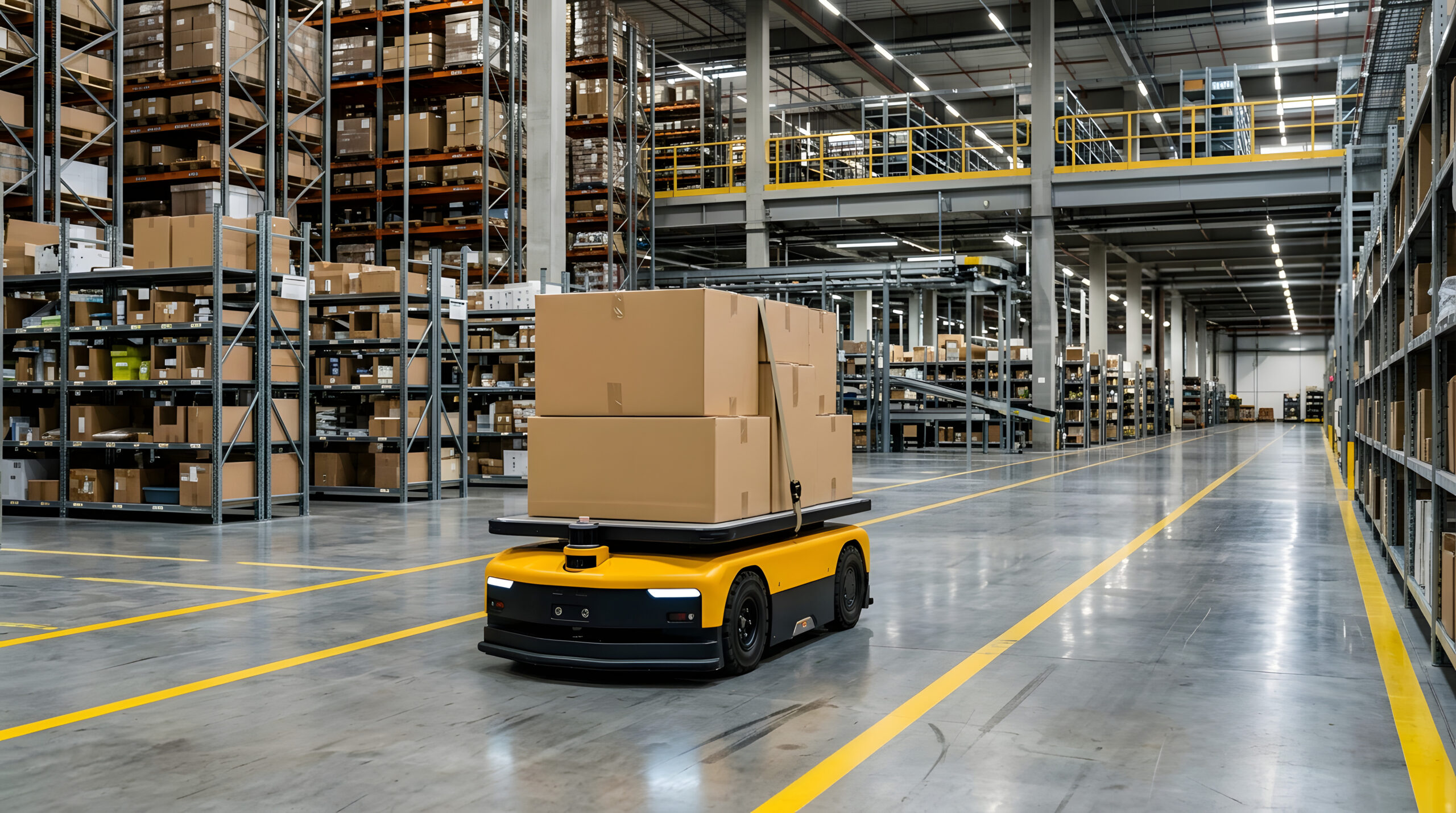
Automated guided vehicles and autonomous mobile robots depend on sensor arrays for navigation and collision avoidance. Those sensors sit behind protective covers, and the covers are not passive. The material, coating, and geometry of each cover directly affect whether the sensor performs to specification at commissioning and whether it continues to perform two years into warehouse operation. Getting the cover specification wrong does not just cause replacement costs: it causes navigational errors in live production environments.
This post covers the optical and mechanical requirements that AGV and AMR sensor covers must meet, the exposure conditions that degrade them in warehouse settings, and the material properties that determine whether a polycarbonate cover holds up.
Sensor Types and Their Window Requirements
Most AGV and AMR navigation systems combine two or more sensor types, and each places different demands on its protective cover.
LiDAR: Time-of-flight LiDAR systems operate at 905nm or 1550nm, in the near-infrared range. The protective window must transmit efficiently at the sensor’s operating wavelength, not just in the visible spectrum. Standard optical-grade polycarbonate transmits at approximately 90% across the visible range (380-780nm) as measured by ASTM D1003, but transmittance at 905nm can differ depending on material grade, additives, and coating chemistry. Specify NIR transmittance at the sensor’s exact operating wavelength, not visible-light haze alone.
Camera systems: Vision-based navigation cameras require low haze and high luminous transmittance across the visible spectrum. ASTM D1003[1] (Standard Test Method for Haze and Luminous Transmittance of Transparent Plastics) is the baseline test. Haze above 1-2% in the uninstalled cover can produce measurable degradation in machine vision algorithms, particularly in low-contrast environments.
Ultrasonic sensors: Ultrasonic proximity sensors do not require an optically clear window, but they are often housed behind a common cover assembly with LiDAR or camera systems. The cover must not attenuate the ultrasonic signal at the sensor’s operating frequency. Thin polycarbonate panels (under 3mm) at common ultrasonic frequencies (40-200kHz) have negligible signal attenuation when the cover geometry is correctly designed.
Impact Exposure in Warehouse Environments
Warehouse floors are high-energy impact environments. The impact hazards for AGV covers come from three sources: collision with pallets and racking at low speed, accidental contact from powered industrial trucks sharing the same aisles, and dock plate and threshold impacts during loading dock transitions.
Low-speed pallet contact is the most frequent. An AGV decelerating to a stop after contact with a misplaced pallet generates a distributed load across the leading face of the vehicle. Cover panels in forward-facing positions need sufficient thickness and support geometry to absorb this load without cracking or delaminating from the frame.
Powered industrial truck contact is less frequent but higher energy. A forklift counterweight contacting the side of an AGV at crossing speeds typical of shared-aisle environments represents a point impact with substantial energy. ANSI/RIA R15.08 (Industrial Mobile Robots, Parts 1-3) specifies collision energy limits and detection requirements for AMRs operating in shared workspaces, but the standard does not prescribe cover material. The cover specification is an engineering decision by the integrator or OEM.
Dock plate transitions generate repetitive shock loading at the bottom edge of forward covers. In high-frequency inbound/outbound operations, cumulative fatigue loading at panel edges and mounting points should be part of the design review.
Chemical Exposure: Warehouse Cleaning Cycles
Distribution centers and food-adjacent warehouses run aggressive floor cleaning programs. AGV covers are in the splash zone for every cleaning pass. The cleaning agents relevant to polycarbonate cover specification include alkaline floor cleaners (pH 11-13), hydrogen peroxide-based sanitizers, and quaternary ammonium disinfectants.
Uncoated polycarbonate is susceptible to stress crazing when cleaning agents contact surfaces under residual mechanical stress. Panels with residual forming stress, tight mounting hardware, or sharp radius bends at mounting edges are highest risk. Crazing begins as optical haze and progresses to micro-cracking, which permanently degrades sensor window clarity.
Hard-coated polycarbonate resists crazing from cleaning agents when the coating is chemically compatible with the agents in use. Request chemical resistance data for the specific agents used at the installation site before specifying a coating grade. A coating that passes ASTM D1308 for common industrial cleaners may still craze under repeated contact with a specific quaternary ammonium formulation used at a particular facility.
The Standards Framework
OSHA currently has no specific standards for the robotics industry, as noted on the OSHA Robotics overview page[2]. AGV and AMR safety requirements in the United States are governed primarily by two standards: ANSI/RIA R15.08 (Industrial Mobile Robots, Requirements for Safety, Parts 1-3) and ISO 3691-4 (Industrial Trucks, Safety Requirements and Verification, Part 4: Driverless Industrial Trucks and Their Systems). Both are technical standards available through their respective standards bodies. Neither prescribes a specific cover material or optical performance threshold. The cover specification is the responsibility of the equipment designer, informed by the sensor manufacturer’s requirements and the site-specific environmental conditions.
This gap between safety standard and component specification is where cover material decisions are made. The standard defines what the robot must do (stop reliably, detect obstacles, not injure workers). The cover specification determines whether the sensors enabling those functions maintain their required performance across the vehicle service life.
Material Selection: Polycarbonate vs. Alternatives
The primary alternatives to polycarbonate for AGV sensor covers are acrylic (PMMA) and tempered glass.
Acrylic offers slightly higher visible-light transmittance than polycarbonate (92% vs. 88-90%) and better inherent scratch resistance, but it is brittle under impact. In a warehouse environment with pallet contact and forklift interaction risk, the fracture behavior of acrylic is a significant liability. Acrylic does not deform and retain; it fractures and fragments. For sensor covers in shared-aisle AGV applications, acrylic is a poor choice on impact grounds alone.
Tempered glass provides excellent scratch resistance and chemical resistance, but adds weight and introduces fragmentation risk. AGV design is sensitive to front-end weight, which affects drive wheel traction and braking performance. A polycarbonate cover of equivalent optical and mechanical performance is 50% lighter than a glass cover of equivalent thickness, and it does not fragment under impact.
Polycarbonate with a hard coat is the standard choice for AGV sensor covers because it addresses all three failure modes: it survives warehouse impacts without fracturing, it resists abrasion from cleaning equipment and incidental contact, and it maintains optical performance across the visible and NIR spectrum when the coating chemistry is correctly specified for the application.
Five Star’s Capabilities for AGV and Robotics Applications
Five Star Fabricating produces coated polycarbonate components for material handling and warehouse robotics applications. Fusionite-coated polycarbonate is available in multiple grades, with abrasion and chemical resistance data available for specification comparison. Cover geometry including complex curves and precision-machined mounting features is produced in-house.
Five Star’s lab testing capabilities[3] include haze and luminous transmittance per ASTM D1003, Taber abrasion per ASTM D1044, chemical resistance per ASTM D1308, and multiaxial impact testing per ISO 6603-2 and SAE J1615. NIR transmittance testing at specific wavelengths can be coordinated through Five Star’s partner lab network. Test data packages are available before production commitment.
Contact
To discuss sensor cover specifications for an AGV or AMR platform, or to request Fusionite coating test data for a specific chemical exposure profile, contact Five Star Fabricating in Twin Lakes, WI: +1 (262) 877-2171.
View material handling and robotics glazing capabilities and submit a quote request at fivestarfabricating.com/applications/material-handling.
Write a Comment