
- Home
- News & Blogs
- Heavy Equipment
Agricultural Cab Glazing: Chemical Exposure, UV Resistance, and Long-Term Performance
On agricultural equipment the polycarbonate supplies the impact resistance. The hard coat decides how long each window stays clear under pesticide drift, fertilizer, UV, and harvest dust.
In This Article
Sprayer cabs operate in and around the drift of the products being applied. Combines and forage harvesters run through heavy dust and chaff with the wipers running during harvest. Tractors and sprayers stored outdoors between seasons take UV exposure year-round, not only during operating hours. In each case the polycarbonate substrate supplies the impact resistance, while the hard coat determines how long each window stays clear under chemical, UV, and abrasion exposure.
This post covers the enclosed-cab definition in the EPA Worker Protection Standard, the chemical, UV, abrasion, and fogging exposures agricultural glazing faces, what the Fusionite data sheets report for each exposure, and a checklist for writing the glazing specification.
Enclosed Cabs and the EPA Worker Protection Standard
The EPA Agricultural Worker Protection Standard defines an enclosed cab as a cab with a nonporous barrier that totally surrounds the occupants and prevents dermal contact with pesticides applied outside the cab.[1] That makes the cab part of the operator's exposure protection on pesticide application equipment.
Under specified conditions, a handler applying pesticide from inside an enclosed cab may wear a long-sleeved shirt, long pants, shoes, and socks in place of the skin and eye protection listed on the product label. If the label calls for a filtering facepiece or dust/mist respirator, it does not need to be worn inside the cab when the cab has a properly functioning air ventilation system that is used and maintained according to the manufacturer's instructions.[2]
Cracked panels and failed window seals open paths through that barrier. Glazing condition bears directly on the protection the standard assumes an enclosed cab provides.
Cab Pressurization
NIOSH evaluated agricultural cabs in the field and in the lab, measuring filter effectiveness, air leakage into the cab, and protection factors. The evaluations found leakage paths that reduced protection, including filter gaskets that deformed over time. Based on that work, the ASAE S525 consensus standard set a minimum enclosure static pressure of 6 mm of water and a maximum penetration of 2% for particles larger than 3 µm.[3] ANSI/ASABE S613-4[4] defines a performance test for cabs used in contaminated environments. Window fit, frame design, and seal material all affect whether a cab holds pressure, so they belong in the cab specification along with the filter system.
Chemical Exposure in Agricultural Cabs
Spray drift and residue from crop protection products, liquid fertilizer, diesel fuel and diesel exhaust fluid at refueling, hydraulic fluid at implement connections, and the detergents and degreasers used during washdown all reach the exterior glazing of an agricultural cab.
Polycarbonate is prone to environmental stress cracking: a chemical that leaves an unstressed panel unaffected can craze a panel carrying mounting or forming stress. Uncoated polycarbonate also has poor resistance to aromatic hydrocarbons, and many emulsifiable concentrate pesticide formulations use petroleum-based solvent carriers.
On a sprayer cab, the hard coat is the layer keeping solvent carriers off the polycarbonate substrate.
Machined edges and fastener holes cut after coating expose bare polycarbonate and concentrate mounting stress. Edge finishing, mounting design, and sealant and gasket compatibility are part of the chemical specification.
What the Fusionite Data Sheets Report
The Fusionite data sheets[5] list chemical resistance results by grade.
Passes resistance testing against gasoline, kerosene, soap, denatured alcohol, antifreeze, 0.1N sulfuric acid, and 0.1N sodium hydroxide.
Adds urea, diesel fuel, brake fluid, transmission fluid, and bug and tar remover, tested to the FCA LP-463PB-31-01 automotive OEM protocol. Urea matters in agriculture because it is a widely used nitrogen fertilizer and the active ingredient in diesel exhaust fluid.
Lists the same chemical set as CGIII except sodium hydroxide.
None of the Fusionite data sheets list crop protection products in their chemical resistance testing. Formulations vary by active ingredient, solvent carrier, and adjuvants, so results for one product do not carry over to another. Spray frequency, and with it chemical contact, varies by crop and region. For sprayer and applicator cabs, request spot or immersion testing per ASTM D1308 using the specific products the equipment will apply. Test at full concentrate strength as well as tank-mix dilution, since mixing and loading involve full-strength product.
Mining equipment faces a similar exposure-to-coating problem with blasting residue and mining fluids, covered in Mining Equipment Cab Windows: Dust, Chemical Exposure, and Impact Ratings.
UV Exposure in Field Operation and Outdoor Storage
Agricultural equipment runs long daylight hours during planting and harvest, and many machines are stored outdoors between seasons. Uncoated polycarbonate yellows under UV exposure, and the yellowing comes with lower light transmission and surface embrittlement. Exterior agricultural glazing needs UV protection, and on coated polycarbonate that protection comes from a weatherable hard coat with UV stabilizers.
The CGI data sheet reports four years of Florida outdoor exposure (45 degrees south, clear) per ASTM D1435 at below 4% haze and below 4 yellowness index. The CGII data sheet reports five years of Florida outdoor exposure (5 degrees south, clear) per ASTM D1435 at 2.1% haze and 1.8 yellowness index, and accelerated weathering (15,000 kJ, clear) per ASTM G155[6] Modified at below 8% haze and below 2 yellowness index.
The amount of UVB radiation reaching the ground depends on latitude, altitude, and time of year, according to the EPA.[7] Equipment that works and is stored at lower latitudes or higher elevations takes a heavier UV load than the same machine in a northern, low-elevation operation.
Accelerated weathering is useful for comparing coatings, but accelerated exposure does not convert directly into years of field service. For equipment stored outdoors, outdoor exposure data is the better indicator of long-term performance.
The CGI, CGII, CGFII, and CGIII data sheets list availability on PolyCool material, which they describe as allowing natural light plus heat reduction.
Abrasion and Fogging
Wiper-Swept Glazing
Harvest dust, chaff, and field soil settle on every exterior glazing surface. On wiper-swept windows, the wiper moves that grit across the surface as an abrasive slurry. Pressure washing and brushing during cleanup add more abrasive contact.
Fusionite CGI holds Taber delta haze below 4% at 500 cycles per ASTM D1044, and below 4% after 2,000 wiper cycles with an aqueous dust suspension per ISO 5685. CGIII holds below 2% at 1,000 Taber cycles and below 2% after 20,000 wiper cycles, with falling sand abrasion below 8% per ASTM D968. For a full explanation of Taber, falling sand, and wiper abrasion results, see The Complete Guide to Hard Coat Ratings for Polycarbonate Windows.
Fogging and Condensation
Cabs started on cold mornings, run with HVAC in humid conditions, or used for early spring fieldwork can fog on interior glazing surfaces. The CGAF data sheet describes it as a coated product with long-term anti-fog properties, very good chemical resistance, moderate abrasion resistance, and formability. It reports fog-free performance for more than two minutes at 60°C and Taber delta haze below 30% at 100 cycles, and states that it meets EN-166:2001 protective eyewear requirements for anti-fog, falling sand abrasion, and UV resistance. The CGAF data sheet does not include a DOT ANSI Z26.1-1996 compliance listing.
Specification Checklist for Agricultural Cab Glazing
For engineers writing polycarbonate glazing specifications for agricultural equipment:
- Chemical list — list every chemical the machine will contact, including crop protection products, fertilizers, fuels, diesel exhaust fluid, and cleaning agents, and request test data or spot testing against that list.
- UV data — request outdoor exposure data for equipment that will be stored outdoors.
- Abrasion — specify Taber delta haze per ASTM D1044 at a stated cycle count, plus wiper abrasion per ISO 5685 for wiper-swept positions.
- Pressurization — include window fit and seal material in the cab pressurization review, and confirm sealants and gaskets are compatible with polycarbonate.
- Production parts — confirm chemical, abrasion, and optical results on the coated, formed production part rather than a flat test coupon.
Five Star's Agricultural Cab Glazing Capabilities
Five Star Fabricating applies Fusionite coatings to polycarbonate sheet and molded components in its coating facility, which handles coated sheets up to 8 feet by 11 feet. The Fusionite CGI, CGII, CGIII, and CGAF data sheets[5] list heavy equipment and agriculture cabs as a typical application. See Five Star's heavy equipment glazing page for cab window capabilities.
- Light transmission and haze — ASTM D1003
- Taber abrasion — ASTM D1044
- Falling sand abrasion — ASTM D968
- Chemical resistance — ASTM D1308
- Weathering — ASTM G154 and SAE J2020, through accredited partner labs
Details are on Five Star's lab testing capabilities[8] page. Five Star's engineering and design team supports cab glazing programs from CAD through production, and custom prototypes are typically delivered within two weeks of initial consultation and CAD file submission.
Coating grade, seal design, and chemical validation are all set early in a cab program, and each depends on how the machine will be used. Sharing the chemical list, storage conditions, and wiper layout with Five Star at the specification stage allows coating data and test results to be matched to the actual cab before production.
References
- 40 CFR 170.305: Worker Protection Standard, Definitions
- 40 CFR 170.607: Exceptions to Personal Protective Equipment Requirements Specified on Pesticide Product Labeling
- NIOSH Engineering Controls Database: Environmental Enclosures for Use in Agriculture
- ANSI/ASABE S613-4 AUG2017 (R2022): Tractors and Self-Propelled Machinery for Agriculture, Air Quality Systems for Cabs, Part 4: Performance Test of a Cab
- Five Star Fabricating: Fusionite Data Sheets
- ASTM G155: Standard Practice for Operating Xenon Arc Lamp Apparatus for Exposure of Materials
- U.S. EPA: Ultraviolet (UV) Radiation and Sun Exposure
- Five Star Fabricating: Lab Testing Capabilities
Related Reading
 ApplicationHeavy Equipment GlazingCab windows and windshields for construction, agricultural, and off-road equipment.
 ArticleMining Equipment Cab WindowsHow cab glazing is specified for silica dust, hydraulic fluids, and high-energy impact.
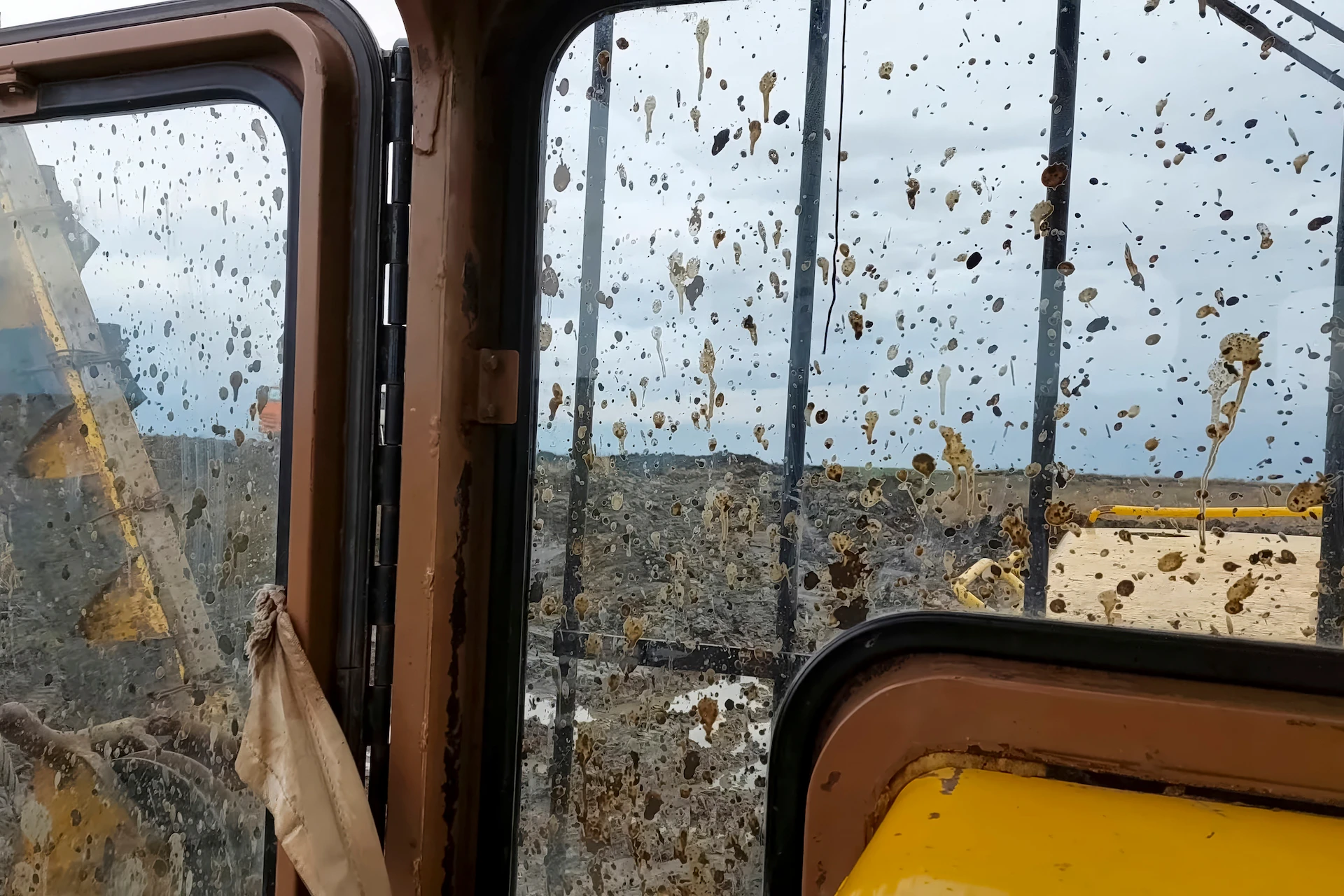 ArticleHard Coat Ratings ExplainedWhat Taber, falling sand, and wiper abrasion numbers mean when comparing coatings.
Spec Your Ag Cab Glazing With an Engineer
Discuss glazing specifications for an agricultural equipment platform, or request test data for a specific coating grade and service environment.