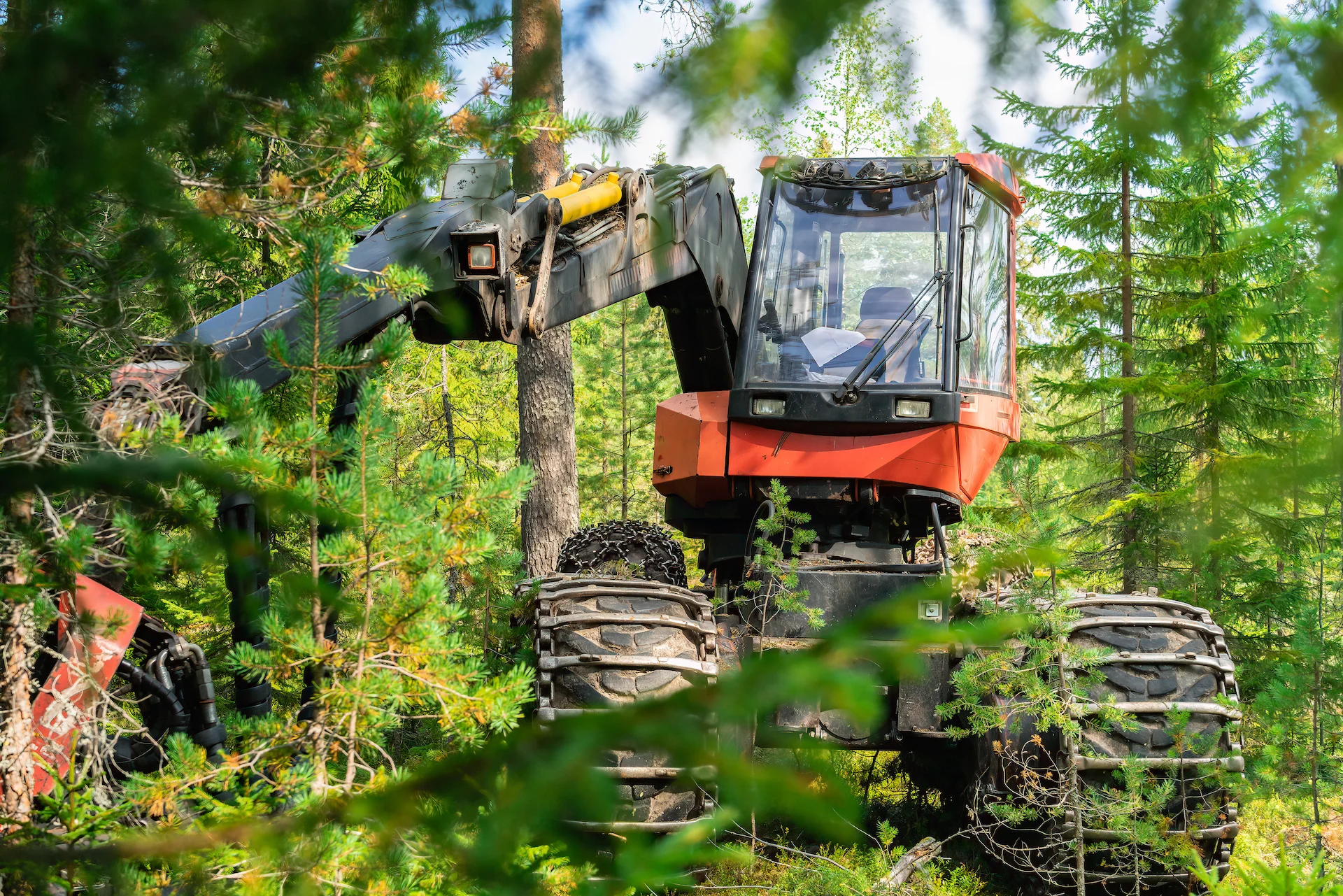
Cab glass failures in forestry equipment are not unusual. They are routine. Operators on feller bunchers, skidders, and harvesters work inside machines that move through dense stands of trees, process timber at high speed, and operate in conditions that generate high-velocity debris on nearly every cycle. The cab is not a protected environment. It is a barrier between the operator and a constant stream of thrown objects, branch contact, chainsaw fragments, bark, and fine abrasive particulate.
Glass fails in this environment predictably. Polycarbonate does not have the same failure modes. That distinction is not a sales argument. It is a material engineering question with a clear answer, and the standards bodies that govern forestry equipment safety have already weighed in.
What Forestry Does to Cab Glazing
NIOSH data on logging places it among the most hazardous industries in the United States, with a fatality rate more than 21 times the national average across all industries. OSHA’s logging operations standard, 29 CFR 1910.266, reflects this risk profile.
Cab integrity is central to operator protection.
The threats that make forestry cabs difficult to glaze fall into three categories.
Thrown Objects
Feller bunchers cut trees at the base and rotate the stem. Skidders drag logs across uneven terrain. Every phase of the timber harvest cycle generates debris: bark, chips, rocks, and root material that move at velocity and in unpredictable directions. ISO 11839, the thrown object guard standard for earth-moving and forestry machinery, was written specifically because this hazard is consistent enough across machine types to require a standardized engineering response.
Chainsaw Fragments
Harvesters and processing equipment operate saw chains at high rotational speed. Saw chain shot, the projection of chain links or chain segments under failure conditions, is a recognized hazard with its own ISO standard: ISO 21876. A glazing system that cannot contain a chain fragment under test conditions is not appropriate for a harvester cab.
Abrasion from Sustained Contact
Skidders and forwarders push through brush. Branch contact scratches glazing surfaces on every pass. Dust from bark, soil, and wood fiber accumulates on windshield surfaces and is wiped into the coating repeatedly throughout a shift. Over a season, this abrasion accumulates in ways that degrade operator visibility well before the window reaches the end of its expected service life.
Glass fails on all three of these vectors. Polycarbonate addresses each one differently.
How Glass Fails in Forestry Cabs
Tempered safety glass is designed to break into small, less-sharp pieces when it fails. That behavior is the feature. In a passenger vehicle that has been in a collision, tempered glass breaking into granules rather than shards reduces laceration risk. In a forestry equipment cab that has taken a thrown object strike, the same behavior means the entire pane is out of service and the operator is exposed.
This is the fundamental problem with glass in high-impact environments: the failure mode is complete. There is no partial failure, no dent, no deformation that leaves the cab sealed. When a rock or bark fragment hits tempered glass at sufficient velocity, the pane is gone. Production stops. The replacement window has to arrive before the machine goes back to work.
Beyond impact, glass does not solve the abrasion problem in forestry. Standard float glass and tempered glass have surface hardness in the 6-7 range on the Mohs scale, which sounds high, but does not translate well to abrasion resistance under repeated fine particulate contact. The quartz and silica in bark dust, soil, and wood fiber are hard enough to scratch glass surfaces with consistent wiper use. Operators in dusty environments experience glazing haze accumulation regardless of how carefully they clean the glass.
Weight is the third issue. A large windshield in tempered glass for a forestry harvester cab can weigh substantially more than an equivalent polycarbonate panel. On a machine class where cab structure, ROPS/FOPS certification, and operator ergonomics are already tightly engineered, glazing weight matters for door hinges, seals, and the load path into the cab frame.
Why Polycarbonate Is the Engineering Answer
Five Star’s polycarbonate windows for forestry equipment are rated at 20 times the strength of glass for impact resistance. Polycarbonate does not shatter. Under the impact loads that cause tempered glass to fail completely, polycarbonate deforms, absorbs energy, and stays in place. The cab stays sealed. The operator stays protected. The machine keeps running.
That performance is the reason ISO 11839 and ISO 21876 testing programs point to polycarbonate as the material category capable of meeting thrown object and chainsaw fragment protection requirements. A material that fractures on impact cannot be engineered to pass these tests. One that deforms and retains integrity can be.
Thermoforming polycarbonate to match complex cab geometries is also well within current manufacturing capability. Five Star’s CNC machining and thermoforming operations produce forestry cab windows in flat, pre-contoured, and complex curved forms. Custom drape forming handles the compound curves common in modern harvester cab designs without introducing optical distortion. Frit printing is available for frameless mounting, eliminating the threaded hardware and clips that glass installations typically require.
The Abrasion Problem Requires a Coated Solution
Polycarbonate is not a complete answer without the right surface treatment. Uncoated polycarbonate scratches easily. Its Mohs hardness is well below glass. Operators who have run uncoated polycarbonate in forestry cabs know the result: haze accumulates faster than it did with glass, and the window is out of service in a fraction of the expected service life.
Five Star’s Fusionite proprietary coating line delivers 10 times better abrasion resistance than standard uncoated polycarbonate. Two grades are relevant for forestry applications:
Fusionite CGII is an ultra-weatherable hard coat built for high-UV, high-wiper-cycle environments. It achieves Taber haze below 3% at 500 abrasion cycles per ASTM D1044. Wiper abrasion resistance is below 4% per ISO 5685 and FMVSS 108, which is the relevant spec for cab windows in wet forestry environments where wipers run continuously during rain and washing operations. CGII carries five-year Florida outdoor weathering data, which translates directly to sustained performance in high-sun forestry regions.
Fusionite CGIII is Five Star’s highest-performing abrasion-resistant grade. Taber haze is below 2% at 1,000 cycles, twice the abrasion exposure at a tighter haze limit. CGIII is appropriate for forestry environments with high dust loads, silica-bearing soils, or sustained fine particulate contact where CGII’s 500-cycle spec may not hold over a full season of production.
Fusionite CGAF provides the solution for enclosed cabs with integrated HVAC systems, where temperature differentials between cold morning conditions outside and a warm cab interior can create fogging on the inside surface of the glazing. CGAF is tested at more than two minutes fog-free at 60°C and certified under EN-166:2001. Glazing fog on a harvester cab during a steep-slope felling operation is not a minor inconvenience. It is a visibility hazard.
Built for Forestry, Tested to Standard
Five Star manufactures polycarbonate windows for the full range of forestry equipment: feller bunchers, skidders, harvesters, forwarders, log loaders, and mulchers. Each machine type generates different cab geometry requirements, different debris patterns, and different abrasion profiles. The glazing specification that works for a skidder windshield is not necessarily the same one that works for a harvester’s side window.
Five Star’s engineering team works from customer geometry data, DXF and STEP files, and machine-specific design requirements to produce prototypes within two weeks. In-house lab testing at Twin Lakes, WI covers Taber abrasion (ASTM D1044), wiper abrasion (ISO 5685), UV weathering (ASTM D7869 xenon arc), impact resistance, chemical resistance, and optical clarity (ASTM D1003). Certifications include ISO 9001:2015.
For OEM engineers specifying cab glazing for the next model year, or procurement teams managing replacement windows for an existing fleet, the question is straightforward: the environments forestry equipment operates in are exactly the conditions glass was not designed for. Polycarbonate with the right coating is.
Contact
Contact Five Star Fabricating’s engineering team to request samples of Fusionite-coated polycarbonate or to submit geometry files for a custom prototype.
Twin Lakes, WI: +1 (262) 877-2171
fivestarfabricating.com/applications/forestry